
Culture · Royals on the Rails · 3
Why Is It Called the Jubilee Line?
A royal anniversary in 1977, a prince at the opening in 1979, and the river name left behind.
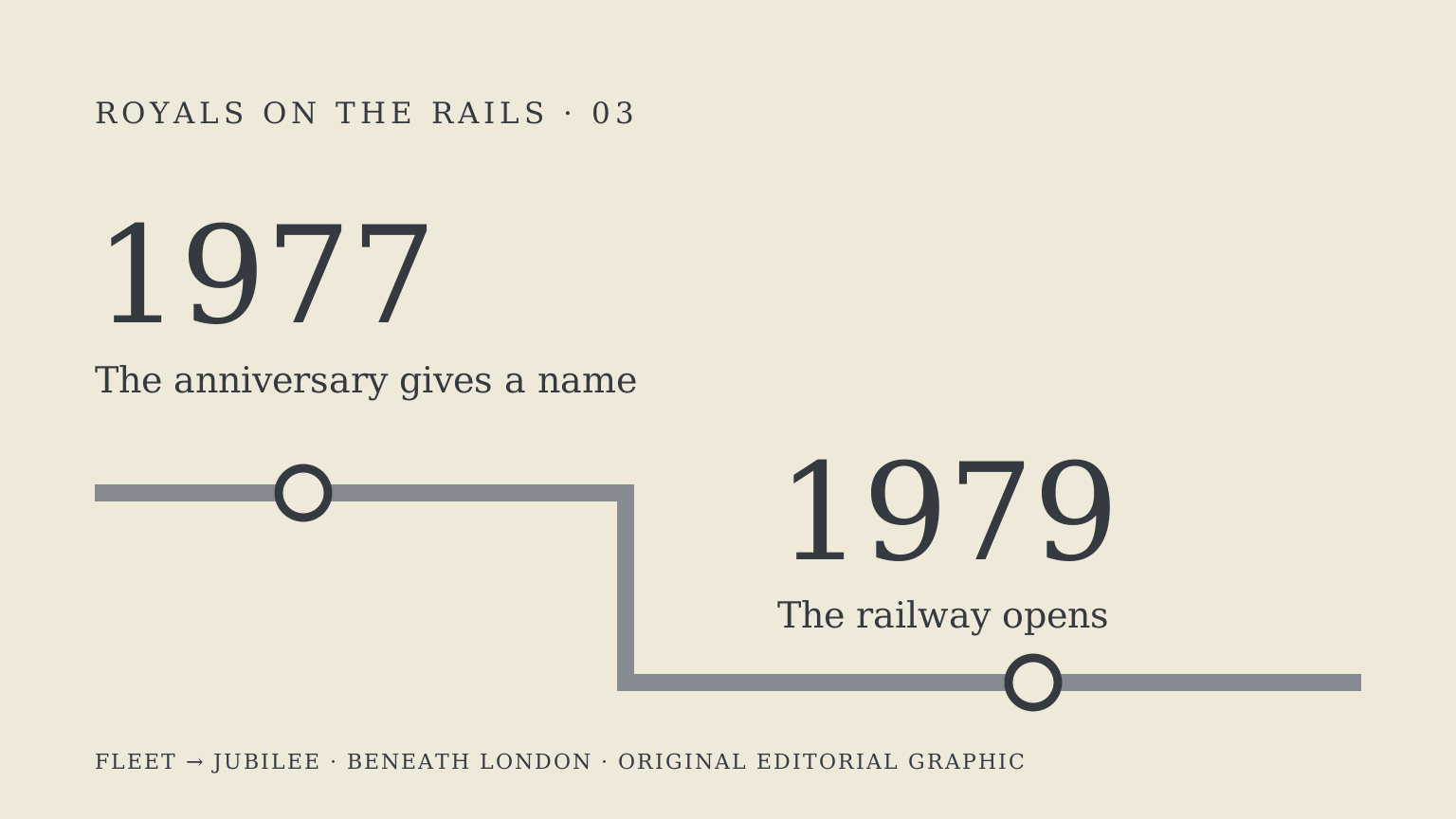
Why is it called the Jubilee line? The railway was renamed from the Fleet line in 1977 to mark Elizabeth II’s Silver Jubilee, twenty-five years on the throne. It opened later: the Prince of Wales performed the ceremony on 30 April 1979, and passenger services began on 1 May.[1][2]
The name contains a small trap. It sounds like a date stamped onto a railway, but the anniversary and the opening belong to different years. The line remembers 1977 even though its first passengers boarded in 1979. That gap is the beginning of its story.
Before Jubilee, there was Fleet
TfL’s archive exhibition traces the Fleet name to proposals in the 1965 report A Railway Plan for London. The intended railway would reach New Cross and Lewisham, with a first stage combining the Bakerloo’s Stanmore branch and new tunnels between Baker Street and Charing Cross. Later stages were to continue east through the City and into south-east London.[3]
Fleet was a geographical name, linked to the river which also gave Fleet Street its name. Jubilee changed what the railway’s title asked passengers to remember: from a feature of London’s landscape to an anniversary of the monarchy.[3]
The change did not wipe the earlier scheme out of the archive. TfL’s exhibition includes a 1975 booklet still advertising the Fleet line’s first stage. A planned railway can acquire a public identity on paper long before it acquires passengers.
A name for the Silver Jubilee
The Royal Collection Trust places the Underground line among the buildings, parks and monuments named for the 1977 celebrations.[4] A transport name was one way to give a temporary occasion a permanent place in everyday speech.
London Museum’s account shows that the jubilee was never just an official procession. There were local street parties and souvenirs, alongside criticism of the cost of royal celebrations during economic hardship. The Sex Pistols’ intervention formed part of that dissent. The museum holds objects made both to commemorate the occasion and to protest against it.[5]
Other projects kept the jubilee in London’s landscape too: the Silver Jubilee Walkway and Jubilee Gardens. The railway’s name belongs to that wider culture of commemoration.[5] It is a reminder of an event people experienced differently, rather than evidence that every Londoner felt the same way about it.
The prince and the opening
TfL’s research guide gives two separate opening dates: the royal ceremony on 30 April 1979 and the beginning of passenger services the following day. The Prince of Wales, Charles, opened the line and the Charing Cross station complex. The first route ran from Stanmore to Charing Cross, incorporating the former Bakerloo branch.[1]
The Royal Household’s later account likewise identifies the Prince of Wales as the person who opened the Jubilee line in 1979, two years after the Silver Jubilee celebrations.[2] The line commemorated Elizabeth II; the opening was performed by her son. Those are related facts, but they are not interchangeable.
Nor should the 1979 terminus be mistaken for the route familiar from a modern map. TfL’s archive describes a major extension in 1999.[1] The name stayed while the railway changed.
A souvenir that became a direction
Most anniversary souvenirs announce themselves as souvenirs. A line name has a different life. It appears in a route instruction, an interchange announcement or a hurried question at a ticket barrier, often with no thought of the event behind it.
That makes Jubilee an unusually successful form of public memory. The anniversary has become useful. A passenger can say the word to find a train without knowing which jubilee it means.
Knowing the history adds another layer to the journey: a river name that nearly became permanent, a royal anniversary that supplied its replacement, and an opening that followed two years later. The railway carries all three stories, even when the map prints only one word.
Royals on the Rails: Continue with The Prince Who Rode into London’s Electric Future, the story of an early electric journey beneath the Thames.
Notes and sources
- TfL Corporate Archives, Research Guide 44: A Brief History of the Jubilee Line, opening historical summary. Renaming, initial route, 30 April ceremony, 1 May passenger service and 1999 extension.
- The Royal Household, “The Queen visits CrossRail”, 22 February 2016. Distinguishes the 1977 celebrations from the Prince of Wales’s 1979 opening.
- TfL Corporate Archives, “Not So Fleeting: The Jubilee Line”. The 1965 plan, Fleet name, proposed stages and 1975 booklet.
- Royal Collection Trust, “Queen Elizabeth II” in Royal Jubilees. The Jubilee line among the permanent commemorative names.
- London Museum, “Pageantry and protest at Elizabeth II’s Silver Jubilee”. Celebrations, dissent and London’s jubilee projects.
Historical details checked 6 November 2026. The accompanying graphic is an original typographic design, not a historical route map or a reproduction of London Transport publicity.