
Culture · Royals on the Rails · 4
The Prince Who Rode into London’s Electric Future
The future Edward VII and a pioneering ride beneath the Thames.
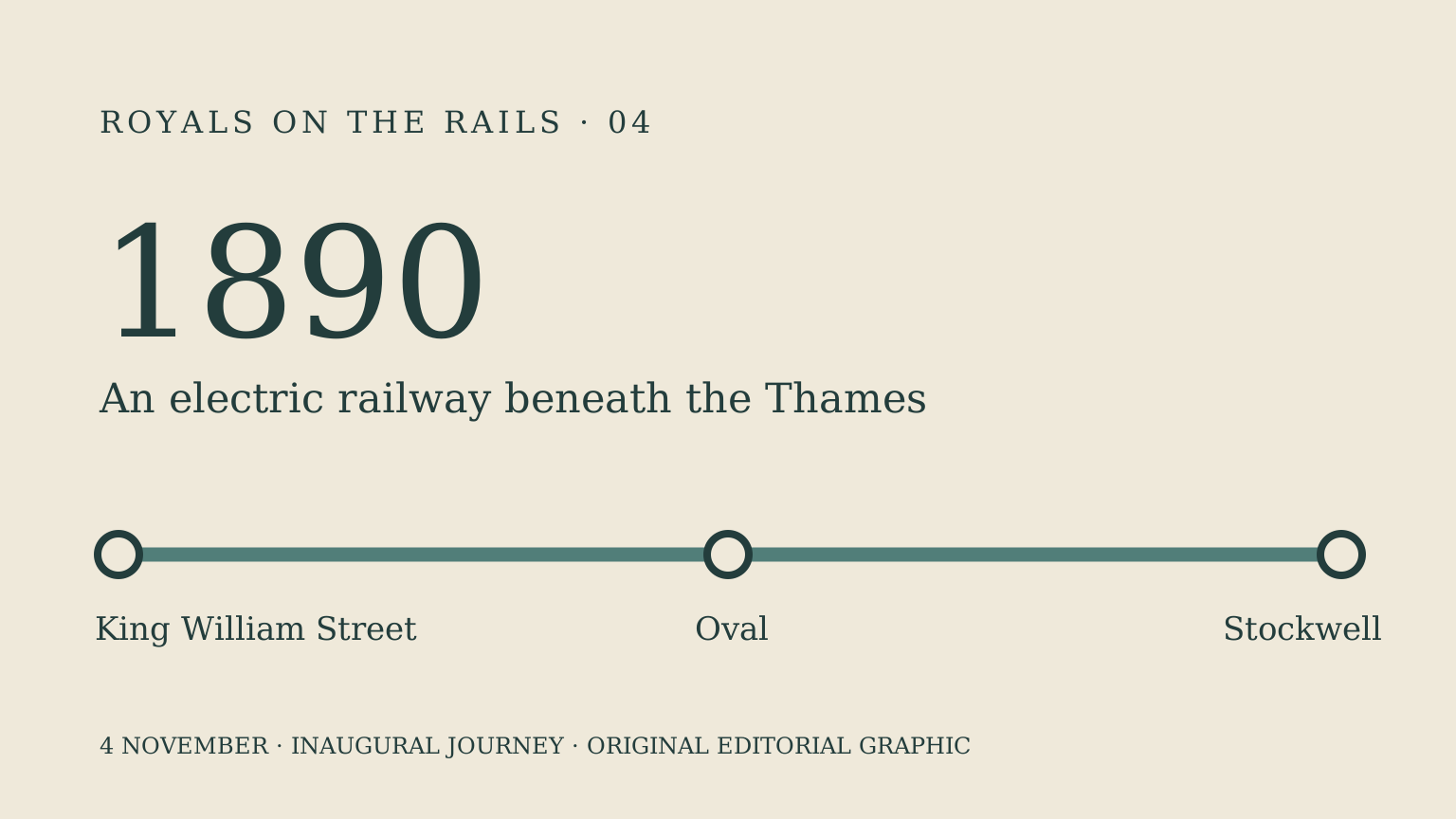
Did the future Edward VII ride London’s first deep-level electric railway? Yes. On 4 November 1890, Edward, then Prince of Wales, inaugurated the City and South London Railway. A contemporary report places him on a train from King William Street to Stockwell, with a brief stop at Oval. Public services began on 18 December.[1][2]
A royal journey under the Thames
The opening began on the City side of the river. The Freemason, reporting that week, says the prince was received at King William Street and turned on the current. The party travelled by train to Oval and then to Stockwell, where a crowd greeted him and a luncheon followed.[1]
The itinerary matters. This was more than a speech at a station: the prince travelled on the railway he was opening. But 4 November was a ceremony for invited guests. Londoners buying a ticket had to wait until December.[1][2]
A different sort of Underground
London already had an underground railway. The Metropolitan opened in 1863 and used steam. What made the 1890 railway a first was the combination of deep tunnels and electric traction. Electricity moved the train without requiring a fire in the locomotive. That mattered in the close confines of a railway built deep enough to pass beneath the Thames.[2][3]
The crossing also made a practical point about the new technology. The prince started in the City and emerged in south London without taking a bridge. The spectacle was the journey itself: an ordinary connection between two places made possible by equipment most passengers would never see.
The station the map forgot
Stockwell survives on the Northern line, but King William Street no longer serves passengers. The original approach was bypassed as the railway expanded; the surviving railway became part of the Northern line.[4] The modern Tube map therefore gives only half the story of the inaugural ride. One terminus is familiar, while the other has disappeared from the passenger network.
Nearly eight decades later, Elizabeth II opened the Victoria line. Her great-grandfather’s ride offers an earlier example of a royal opening used to introduce a transport technology. In 1890 the novelty was an electric railway deep beneath London. In 1969 it was a railway with automatic ticket gates and automatic train operation. Both ceremonies turned something technical into something a passenger could see and try.
Royals on the Rails: Continue with From Crossrail to Elizabeth, the story of a railway named for Elizabeth II.
Notes and sources
- The Freemason, 8 November 1890, p. 12. Contemporary report of the opening and journey via Oval.
- TfL, London Underground’s 160th anniversary chronology. The Metropolitan in 1863 and the start of deep-level electric public service on 18 December 1890.
- London Museum, “When did London get electricity?”. The railway in the history of electric power.
- Royal Observatory Greenwich, “Greenwich Power Station”. Dates, route and Northern line connection; see also Subterranea Britannica’s King William Street station record for the abandoned approach.