
Culture · Royals on the Rails · 2
A Medieval Queen on the Northern Line
Eleanor of Castile, David Gentleman and the people who built a royal memory.
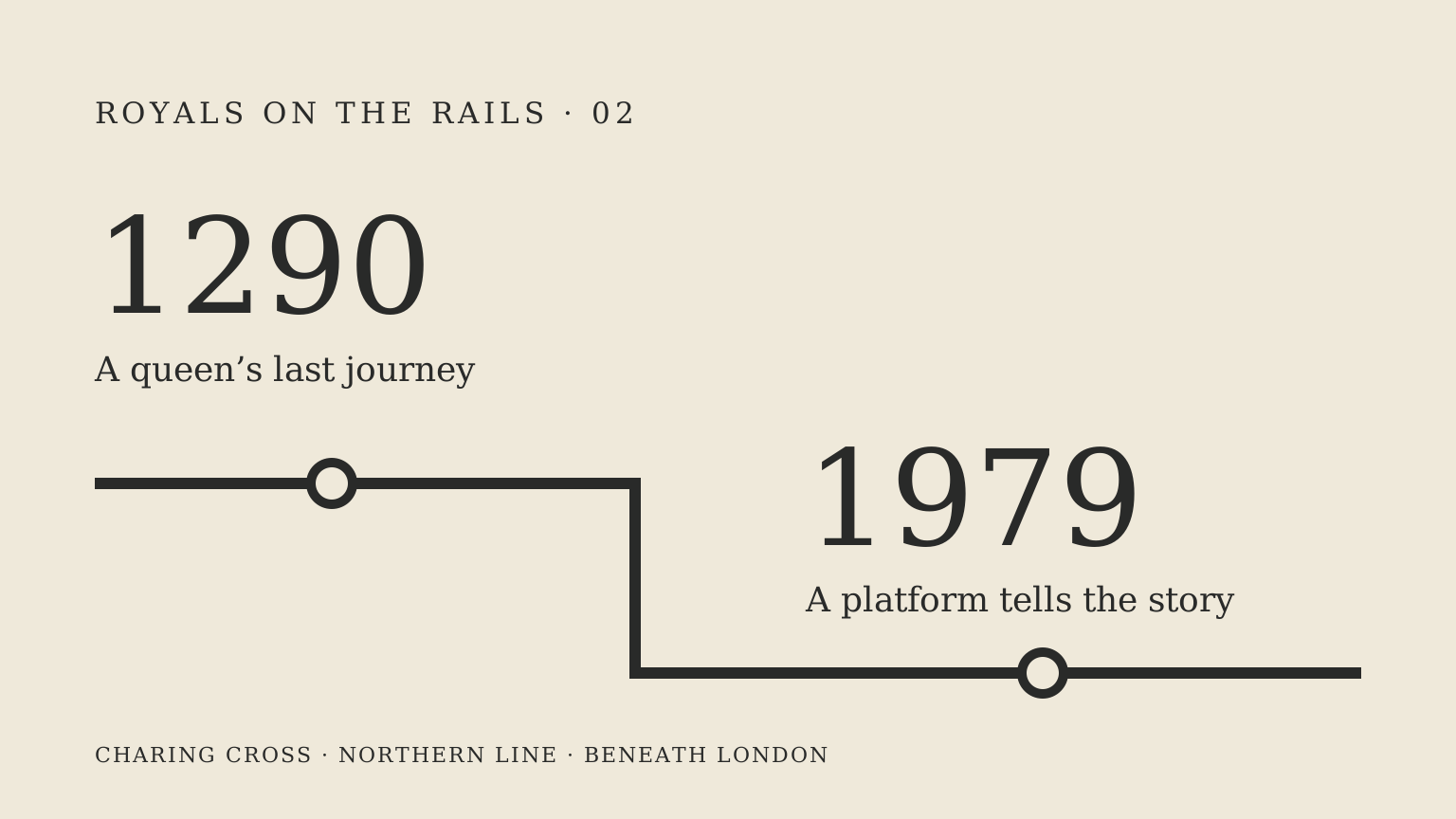
Why is a medieval queen remembered on the Northern line? David Gentleman’s Cross for Queen Eleanor panels at Charing Cross show the making of the memorial that gave the station its second name. Commissioned in 1978 and dated 1979 in TfL’s art guide, the work turns a royal monument into a story about the people who built it.[1]
Some royal Tube stories begin with a sovereign descending an escalator. This one begins with a queen who died centuries before the railway existed. Eleanor of Castile never travelled on the Underground. Her connection is carried by a place-name, a lost monument and a modern artist’s decision about what deserves a platform wall.
A journey before the railway
Eleanor, the wife of Edward I, died at Harby in Nottinghamshire in November 1290. Her body was brought south for burial at Westminster Abbey. Edward commissioned memorial crosses at the places where the funeral procession rested, including Charing. The Abbey also records a separate memorial geography: her heart was buried at Blackfriars, while her Westminster tomb carries a gilt-bronze effigy made by William Torel.[2]
The crosses made a journey durable. An overnight stop could have vanished into the ordinary history of a road; a monument turned it into a location people continued to name. London Museum’s surviving fragments from the Cheapside cross are a reminder that London had two of these memorials, one in the City and one at Charing, near the western end of the Strand.[3]
Here the royal story enters the transport map. A memorial supplied a name that outlived the original stone. The railway inherited the words, and Gentleman gave passengers an account of the work behind them.
The workers in the picture
The artist’s own archive identifies scenes of quarrymen cutting stone, barrow bearers, women mixing mortar, masons setting a keystone, workers on scaffolding, and a master mason with a sculptor. Edward I and his children appear too.[4] The cast is larger than a royal household.
That choice changes the emphasis. A monument can encourage us to remember the person it honours and the person who paid for it. A picture of its construction asks us to notice the people between those two names and the finished object: the carriers, mixers, cutters and builders.
The mural is therefore more than a substitute portrait of Eleanor. It offers a way to look at a royal memorial from the ground upwards. A queen’s commemoration becomes an occasion to picture work.
From wood to platform wall
TfL explains that the images began as wood engravings, enlarged and printed onto laminate panels.[1] That distinction is useful: passengers are looking at a modern station installation made from engraved designs, rather than at medieval images or blocks of carved wood fixed to the platform.
The archive labels the designs 1978; TfL’s guide calls the installed work Cross for Queen Eleanor, 1979.[1][4] Those dates describe stages of a twentieth-century artwork. Neither is the date of the medieval event it depicts.
A sequence suits a station particularly well. People meet it in motion and in fragments, with the next train always capable of interrupting their attention. There is no obligation to see the entire story in one visit. A repeated journey can supply another look.
Three things to keep separate
There is the medieval memorial; there is the later cross outside the mainline station; and there is Gentleman’s Underground artwork. The V&A stresses that the monument outside Charing Cross station is not the medieval original. Its account also points to the surviving sculptural tradition: Alexander of Abingdon made figures for the lost Charing cross as well as for Waltham Cross.[5]
Keeping these objects distinct makes the area more interesting. The platform panels do not merely decorate an old name, and the forecourt monument is not proof that medieval London has survived untouched. Each is a later act of remembering.
Look for Gentleman’s panels on the Northern line platforms. To see his original designs in more detail, follow the artist’s archive in the source notes. The most rewarding question is not simply “Where is the Queen?” It is “Who is doing the work?”
Notes and sources
- TfL, Art Map, Charing Cross entry: David Gentleman, Cross for Queen Eleanor, 1979; commission in 1978; wood engravings enlarged and printed on laminate. The PDF may redirect to TfL’s maintenance page during service interruptions.
- Westminster Abbey, “Edward I and Eleanor of Castile”. Death, funeral route, crosses, heart burial and tomb.
- London Museum, “Cheapside Eleanor Cross fragments”. The London memorials at Cheapside and Charing.
- David Gentleman, “Underground Mural”. The artist’s archive, including individual scene titles and 1978 designs. Artwork remains with its rights holders; no mural image is reproduced here.
- Stuart Frost, V&A, “Charing Cross”, 28 November 2006. Distinguishes the station forecourt memorial from the medieval original and discusses Alexander of Abingdon’s sculpture. Historical display locations in that older article should not be treated as current visitor information.
Historical details checked 26 October 2026. The accompanying graphic is an original typographic design, not a copy of Gentleman’s mural or a reconstruction of an Eleanor cross.