
Culture · Royals on the Rails · 5
From Crossrail to Elizabeth
A royal name in 2016, a plaque in 2022 and the passenger railway that followed.
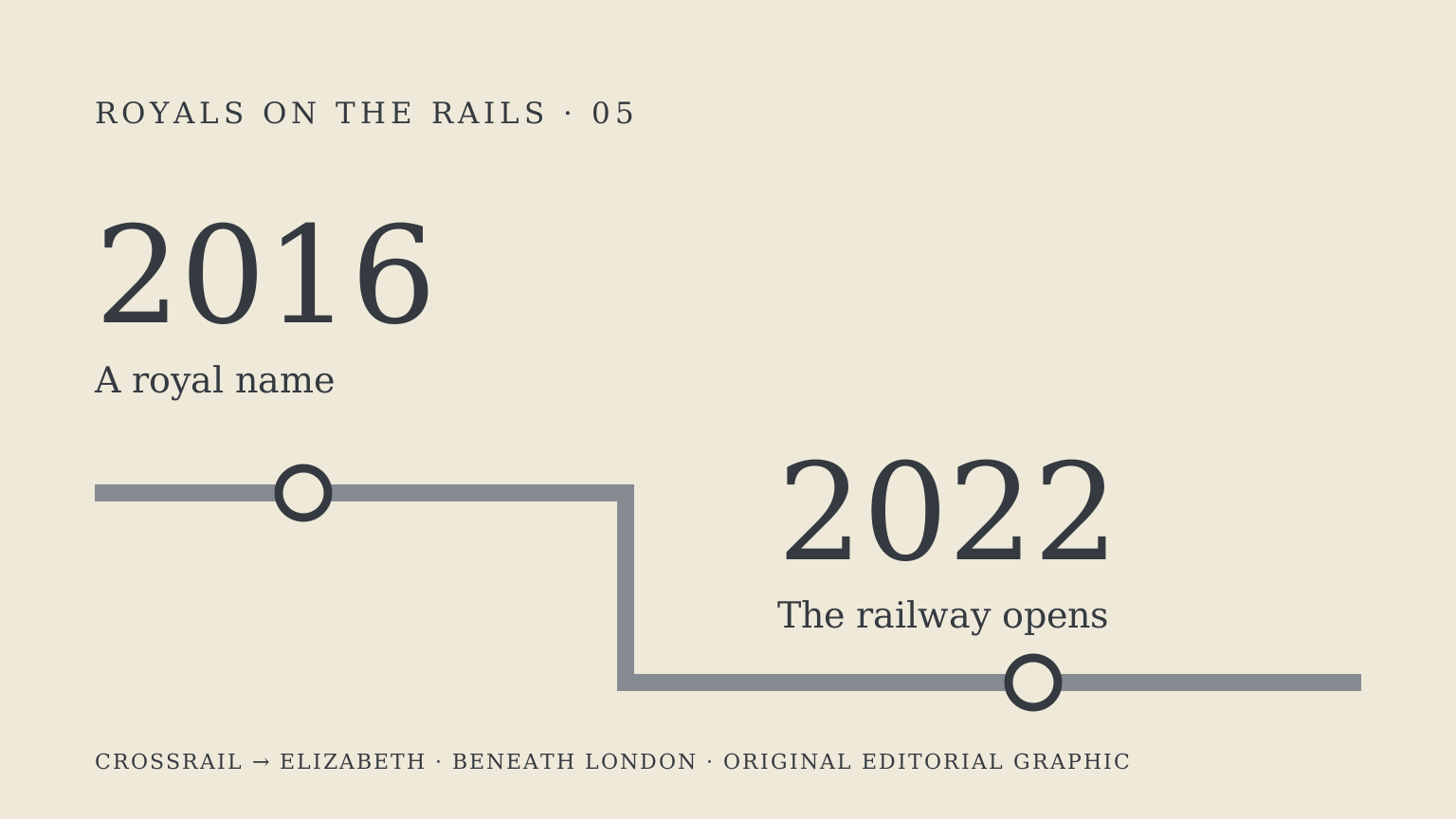
When did Crossrail become the Elizabeth line? The name was unveiled during Elizabeth II’s visit to the Bond Street construction site in February 2016. Six years later she unveiled a completion plaque at Paddington on 17 May 2022. The new central passenger service opened on 24 May. Naming, ceremony and public opening were three different moments.[1][2][3]
A name below Bond Street
In 2016 the railway was still a building site. The Royal Household describes the Queen descending in an industrial lift to inspect the works below Bond Street, meeting apprentices and seeing the tunnel. A purple identity and a plaque announced the new name in her ninetieth year.[1]
Crossrail described a project: a railway crossing London. Elizabeth gave it a person’s name. The change joined a large engineering undertaking to a familiar public figure, making the proposed railway easier to imagine as part of the city’s everyday life.
The Queen at Paddington
On 17 May 2022, the Queen and the Earl of Wessex visited Paddington. She unveiled a plaque marking completion and met people involved in building and running the railway, including apprentices, drivers and station staff.[2]
The Royal Household’s account identifies the Earl as the person who travelled from Paddington to Tottenham Court Road during that visit.[2] It does not describe the Queen taking that train. Her presence at the ceremony should not be retold as a royal ride.
There is a useful distinction here between opening a railway in a ceremonial sense and opening it to passengers. The plaque made the completion official; the timetable would make it useful.
Passengers followed a week later
The Department for Transport’s announcement on 24 May records the public opening. Its examples included a much shorter journey between Abbey Wood and Paddington.[3] For passengers, this was the moment a construction project became a route they could use.
The first service pattern was not yet the fully joined-up railway. TfL’s opening announcement explained that the Elizabeth line would initially operate in three sections. The new central section connected Paddington and Abbey Wood; passengers from the existing western and eastern services still had to change to enter it. Bond Street’s Elizabeth line platforms did not open with the other central stations.[4]
Those details help prevent another compressed version of the story: the idea that everything called Crossrail changed overnight into a single finished service. Its identity could be announced on one day while its passenger connections developed in stages.
A royal name on the map
The Elizabeth line appears on London’s familiar transport map, but it is a separate railway service from London Underground.[5] Its central tunnels and Underground interchanges do not make it another Tube line.
For this series, its place is as a companion to the royal Tube stories. The connection with Elizabeth II is unusually direct: she saw the railway under construction when its name was announced and returned near the end of her reign to mark its completion. The name travelled from a plaque into announcements, signs and daily conversation.
Notes and sources
- The Royal Household, “The Queen visits CrossRail”, 22 February 2016.
- The Royal Household, “Opening the Elizabeth Line”, 17 May 2022. Describes the Queen’s plaque unveiling and the Earl’s train journey separately.
- Department for Transport, Elizabeth line public opening announcement, 24 May 2022.
- TfL, “Elizabeth line to open on 24 May 2022”, 4 May 2022. Initial service sections and Bond Street exception; historical arrangements, not current travel advice.
- Department for Transport, Better Connected: supporting evidence and analysis. Classifies the Elizabeth line as heavy rail, separately from the Underground.
Checked 16 November 2026. Original editorial graphic; no archival photograph reproduced.